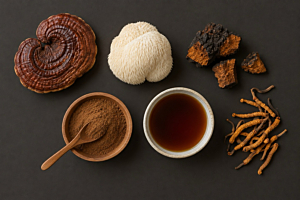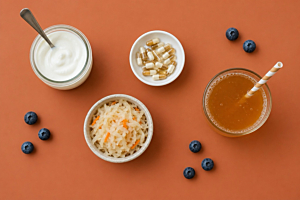
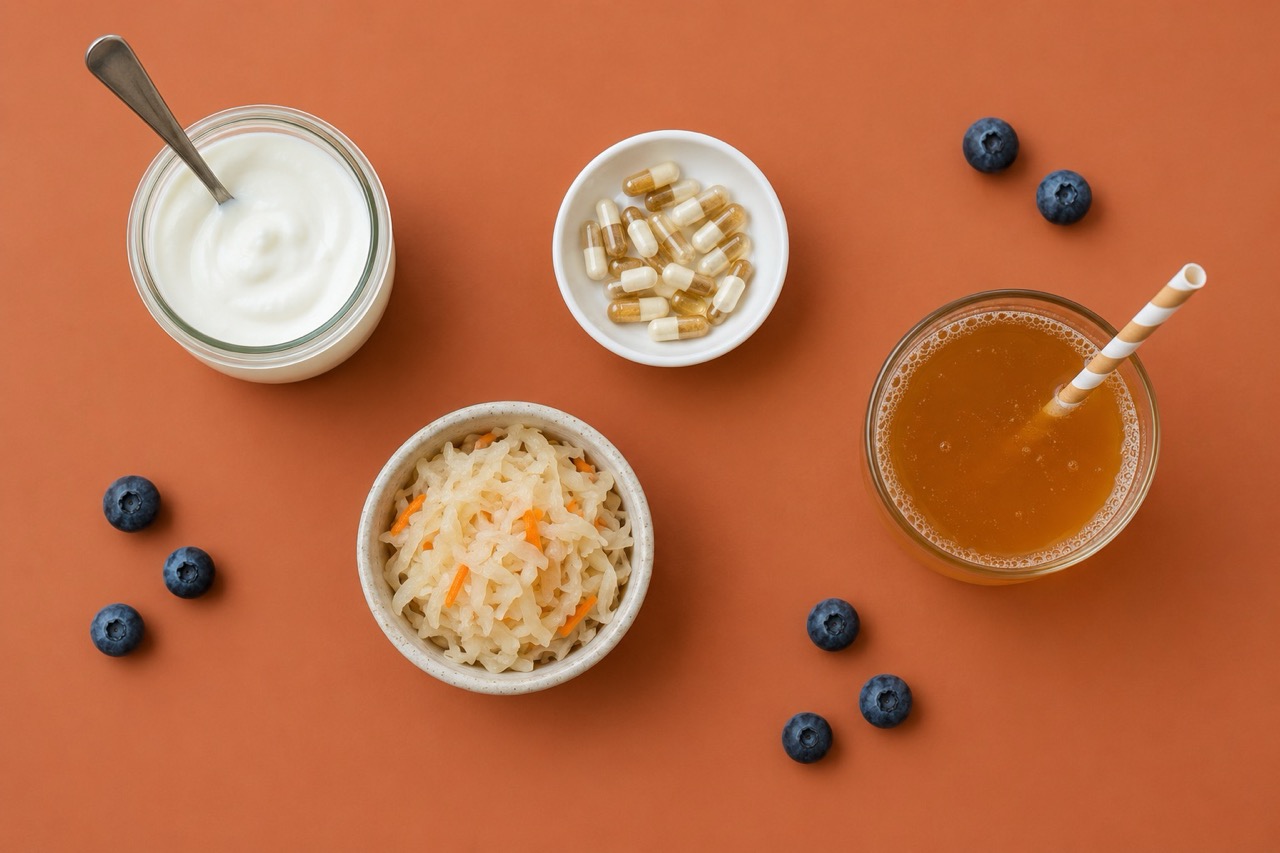
An adult gut hosts trillions of microorganisms, together a full organ weighing one to two kilograms. It helps digest fibre, synthesises B vitamins and vitamin K, trains the immune system and produces compounds that affect mood.
Shelves are full of probiotics, and most buyers pick one by the number of billions on the label. That is close to the least important parameter there is. What follows is what actually determines whether a probiotic helps.
Why the Microbiome Is Not an Abstraction
The composition of gut flora shifts with diet, stress, antibiotics and age. An imbalance is linked to a whole spectrum of problems:
- Bloating, irregular stools, irritable bowel syndrome.
- More frequent infections, since about 70% of the body’s immune cells sit in the gut wall.
- Atopic dermatitis and other skin manifestations.
- Swings in mood and energy: gut and brain are connected by the vagus nerve and by signalling molecules.
- Poorer absorption of minerals and vitamins from food.
The hardest and fastest hit to the microbiome is a course of antibiotics. It reduces the diversity of the flora, and full recovery can take months.
1. The Strain, Not the Genus
A label shows something like Lactobacillus rhamnosus GG. Those are three levels: the genus (Lactobacillus), the species (rhamnosus) and the strain (GG). Effects are proven for strains, not for a genus as a whole. Saying that lactobacilli help with diarrhoea is meaningless, because different strains of the same species can do completely different things.
The practical consequence follows. If a pack says only Lactobacillus acidophilus with no alphanumeric strain designation, you cannot verify what you are buying. A transparent manufacturer always gives the full code: LGG, DDS-1, BB-12, NCFM, HN019, Bifidobacterium longum 35624 and the like.
2. Strains for Specific Jobs
The best-studied applications:
- Recovery after antibiotics: Saccharomyces boulardii, a yeast probiotic that antibiotics do not kill, so it can be taken alongside the course.
- Irritable bowel syndrome: Bifidobacterium longum 35624, and some multi-strain combinations.
- General digestive support: Lactobacillus rhamnosus GG, Lactobacillus acidophilus NCFM.
- Women’s flora: Lactobacillus reuteri RC-14, Lactobacillus rhamnosus GR-1.
- Infant colic and digestion: Lactobacillus reuteri DSM 17938.
- Immune support: Bifidobacterium lactis HN019, BB-12.
There is no universally best probiotic. There is a probiotic that fits what you are trying to achieve.
Probiotics in the catalogue
See all Oral Probiotic Formula 3 Billion CFU, Swanson, 30 tablets, natural strawberrySpecial Price 587 uah Regular Price 645 uah
 Bacillus Coagulans, Bacillus Coagulans, Solaray, 5 billion CFU, 60 vegetarian capsulesSpecial Price 818 uah Regular Price 898 uah
 Multidophilus Probiotic 12 Strains, Solaray, 50 vegetarian capsulesSpecial Price 818 uah Regular Price 898 uah
 Pearls Complete Probiotic, Pearls Complete Probiotic, Nature's Way, 30 soft capsulesSpecial Price 824 uah Regular Price 905 uah
 Primadophilus Reuteri Powder, Nature's Way, 141.75 gSpecial Price 1 121 uah Regular Price 1 231 uah
 Lactobacillus Gasseri, Lactobacillus Gasseri, Swanson, 3 billion CFU, 60 vegetarian capsulesSpecial Price 890 uah Regular Price 978 uah
 L. Reuteri Plus, L. Reuteri Plus, Swanson, 7 billion CFU, 30 vegetarian capsulesSpecial Price 660 uah Regular Price 725 uah
 Femflora Probiotic for Women 9.8 Billion, Femflora Probiotic for Women 9.8 Billion, Swanson, 60 capsulesSpecial Price 603 uah Regular Price 662 uah
3. What CFU Actually Means
CFU stands for colony forming units, the count of live microorganisms. The rule here is not more is better but enough for this strain:
- 1-10 billion: the working range for daily support in a healthy person.
- 10-50 billion: after a course of antibiotics, or with pronounced symptoms.
- 50-100+ billion: specialised regimens, appropriate only on a specialist’s advice.
A different question matters far more: is that 20 billion at the time of manufacture, or at the end of shelf life? Bacteria die off during storage. At time of manufacture means the product can reach you carrying a fraction of the stated count. Look for guaranteed through expiration, or an equivalent statement about the end of shelf life.
4. How Bacteria Survive to the Gut
Gastric juice has a pH of about 1.5-3.5, which is a lethal environment for most probiotic bacteria. The technologies that solve it:
- Acid-resistant delayed-release capsules (DRcaps, enteric coating) dissolve in the intestine instead.
- Microencapsulation puts each bacterium inside a protective matrix.
- Spore-forming strains of the Bacillus genus (Bacillus coagulans, Bacillus subtilis DE111) are naturally protected by spores and mind neither acid nor room temperature.
If none of these is stated, take the probiotic on an empty stomach or just before a meal, when stomach acidity is lower.
5. Prebiotics and Synbiotics
Probiotics are the bacteria themselves. Prebiotics are their food: soluble fibre we cannot digest and the flora ferments. The main types:
- Inulin and fructooligosaccharides (FOS): chicory, Jerusalem artichoke, garlic, onion.
- Galactooligosaccharides (GOS).
- Resistant starch: cooked and cooled potatoes and rice, green bananas.
- Beta-glucans: oats, barley, functional mushrooms.
The two combined in one supplement is called a synbiotic. For people with bloating and IBS, inulin and FOS can worsen symptoms at first, so it is better to start with a plain probiotic and build prebiotics up gradually.
Prebiotics and fibre
See all Glucomannan Rhizome Extract, Glucomannan Rhizome Extract, Solaray, 600 mg, 100 vegetarian capsulesSpecial Price 627 uah Regular Price 689 uah
 Psyllium, Psyllium Husk, NOW Foods, 500 mgAs low as 660 uah Regular Price 725 uah
 Psyllium, Psyllium Husk Fiber Powder, Solaray, 175 g powderSpecial Price 1 002 uah Regular Price 1 101 uah

 Psyllium 700 mg + Pectin, Psyllium Husk 700mg + Pectin, NOW Foods, 180 vegetarian capsulesSpecial Price 792 uah Regular Price 870 uah
 Psyllium, Psyllium Husks, Swanson, 610 mg, 100 capsulesSpecial Price 303 uah Regular Price 332 uah
 Psyllium Whole, Psyllium Husks Whole, NOW Foods, 454 gSpecial Price 776 uah Regular Price 852 uah
 Psyllium, Psyllium Husk, Solaray, 525 mg, 100 vegetarian capsulesSpecial Price 514 uah Regular Price 564 uah
6. Storage and Format
- The cold chain: classic lacto- and bifidobacteria often need refrigeration. Check the requirement on the pack and the delivery conditions.
- Shelf-stable formulas travel better, but make sure the stability is confirmed by the manufacturer rather than merely claimed.
- Powders suit children and allow flexible dosing. Do not mix them into hot drinks.
- Probiotic yoghurts and drinks are a pleasant addition, but the dose and the strain list are usually far more modest than in a supplement.
7. How to Take It and When to Expect an Effect
- During a course of antibiotics, leave 2-3 hours between the antibiotic and the probiotic. Saccharomyces boulardii is the exception and can go together with it.
- Keep taking it for at least 2-4 weeks after the antibiotic course ends.
- For digestive complaints the effect is usually noticeable after 2-4 weeks of consistent use.
- Mild bloating in the first few days is normal adaptation. If it lasts more than a week, reduce the dose.
- Do not rotate products weekly; give one strain formula time to show a result.
8. Who Needs to Be Careful
Probiotics are safe for the great majority of people, but there are exceptions where they should only be taken under a specialist’s supervision:
- Severe immunodeficiency, including from immunosuppressive courses, the period after an organ transplant.
- A central venous catheter in place.
- Critical conditions, severe pancreatitis.
- Premature infants, only on a neonatologist’s recommendation.
Why Choose EcoHuman?
In the gut flora section we select products by exactly the criteria described above:
- Descriptions carry full strain names with their alphanumeric codes, not just the genus.
- Formulas with CFU guaranteed through the end of shelf life.
- Spore-forming and encapsulated options for anyone who needs stability without a fridge.
- Synbiotics and standalone prebiotics for building fibre up gradually.
- Children’s formats in drops and powders.
- Advice that matches a strain to what you actually need.
Conclusion
When choosing a probiotic, ask three questions in this order: which strains are inside, is the live count guaranteed to the end of shelf life, and how will they survive the stomach. The number of billions comes last in importance, even though it comes first in label size. No capsule replaces a diet rich in fibre, fermented foods and varied plant sources, because those are what feed your own flora every day.
Self-medication can be harmful to your health. Consult a doctor before taking dietary supplements.