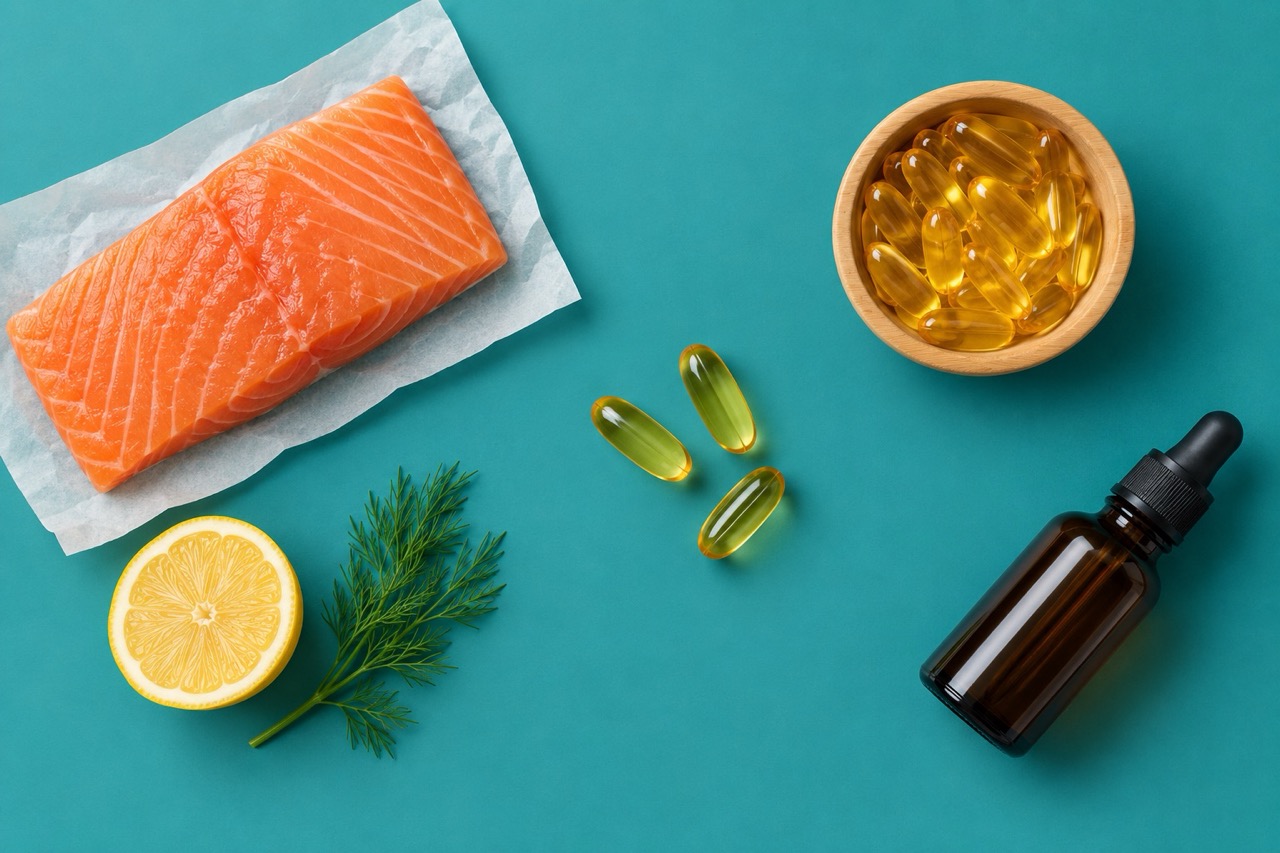
Omega-3 is among the most popular supplements in the world, and at the same time it is the category where the gap between a good and a bad product is widest. Two jars can cost the same and both promise 1000 mg of fish oil, yet deliver completely different amounts of the active substance. The reason is simple: the label usually states the weight of the oil, not the weight of the omega-3 acids in it.
What follows is what to look for on the pack, how the molecular forms differ, why the oxidation figure matters, and how much omega-3 you actually need.
Why Nothing Else Replaces Omega-3
EPA (eicosapentaenoic) and DHA (docosahexaenoic) acids are essential: the body does not make enough of them on its own. They are built into cell membranes and shape how those cells work.
- DHA is the main structural fat of the brain and the retina. It matters most during pregnancy and in a child’s first years.
- EPA takes part in regulating inflammation. Most of the anti-inflammatory effects of fish oil are linked to it.
- Both acids affect blood triglyceride levels. That is the best-evidenced effect of omega-3.
- An adequate intake is associated with joint and skin health and with cognitive function in later life.
Plant omega-3 (ALA from flax, chia, walnuts) is not a substitute. The body converts ALA to EPA at roughly 5-10% efficiency, and to DHA at under 1%. Flaxseed oil is useful, but it does not do the job of fish oil.
1. The Big Number on the Label Is Not the One That Counts
The most common trap looks like this: Fish Oil 1000 mg in large type on the front, and EPA 180 mg, DHA 120 mg in small type on the back. So a gram of oil holds only 300 mg of omega-3; the rest is other fats. That is a classic 30% concentrate, and it is not bad in itself. But products have to be compared on total EPA+DHA per serving, not on the weight of the oil.
- Standard fish oil: about 30% omega-3, so 300 mg of EPA+DHA per 1000 mg.
- Concentrate: 50-60%, so 500-600 mg per 1000 mg.
- High concentrate: 70-85%, where a daily dose fits into one or two capsules.
Work out the price of a gram of EPA+DHA rather than the price of the jar. The ranking of the products on the shelf often flips completely after that.
2. The Molecular Form: Triglycerides, Ethyl Esters, Phospholipids
This is the second most important parameter, and the second most often left unsaid.
- Natural triglycerides (TG): the form omega-3 exists in inside a fish. Best absorbed, but limited in concentration.
- Ethyl esters (EE): the product of concentration. Cheaper to make, absorbed less well, especially without a fatty meal. Most inexpensive concentrates are these.
- Re-esterified triglycerides (rTG): a concentrate converted back into triglyceride form. Combines high concentration with good absorption, and costs more.
- Phospholipids (krill oil): omega-3 bound to phospholipids together with astaxanthin. Absorbed well, but the EPA+DHA dose per capsule is usually small.
If the form is not stated on the label at all, it is very likely ethyl esters. Transparent manufacturers print TG, rTG or EE in the ingredients.
3. Freshness Changes Everything
Omega-3 is a very unstable molecule: it oxidises on contact with oxygen, light and heat. Oxidised fish oil does not merely lose its benefit; the oxidation products are pro-oxidants themselves. Independent testing on various markets regularly finds batches above the accepted oxidation limits.
What to check:
- The TOTOX figure, the total oxidation index. The industry limit is 26; good manufacturers publish values below 10 and include a batch certificate of analysis.
- An antioxidant in the formula: natural tocopherol (vitamin E) or rosemary slows oxidation.
- Dark glass or an opaque blister instead of a clear plastic jar.
- Smell and taste: a sharply fishy or bitter capsule means the oil has already oxidised. A fresh product tastes mild and neutral.
- The production date, not just the expiry date. The fresher the batch, the better.
4. Raw Material and Purity
Fish accumulate mercury, dioxins and polychlorinated biphenyls. Molecular distillation removes those contaminants, but not every producer does it.
- Small, short-lived fish (anchovies, sardines, mackerel) accumulate fewer heavy metals than large predatory species.
- Molecular distillation should be stated on the pack or in the product description.
- IFOS, GOED and Friend of the Sea certificates give independent confirmation of purity and sustainable sourcing.
- The vegan alternative: algae oil. It is the original source of DHA in the food chain, with no predatory-fish contamination risk.
5. How Much a Day
The reference points from international guidance, expressed as total EPA+DHA:
- General adult health: 250-500 mg a day.
- Heart and vascular health: around 1000 mg a day.
- Elevated triglycerides: 2000-4000 mg, but only on a specialist’s recommendation.
- Pregnancy and breastfeeding: at least 200-300 mg of DHA on top of the baseline.
Calculate your own dose like this: look up EPA+DHA per capsule and divide your target by that number. It often turns out that three capsules are needed where the label suggests one, and at that point the cheap jar stops being cheap.
Omega-3 in the catalogue
See all
 Prenatal DHA, Prenatal DHA, Nordic Naturals, 90 strawberry-flavored softgelsSpecial Price 1 476 uah Regular Price 1 621 uah
 Natural Omega 3, Natural Omega 3, Stark PharmAs low as 263 uah Regular Price 289 uah
 Mega EPA/DHA Omega-3 Fish Oil, Life Extension, 120 softgelsSpecial Price 1 398 uah Regular Price 1 536 uah
 OmegaEPA Fish Oil, Source Naturals, 1000 mg, 100 softgelsSpecial Price 794 uah Regular Price 872 uah
 Ultra Omega-3 Fish Oil, NOW Foods, 180 softgelsSpecial Price 1 841 uah Regular Price 2 023 uah
 Omega-3D, Omega-3D, Nordic NaturalsAs low as 951 uah Regular Price 1 045 uah

6. The Omega-6 to Omega-3 Ratio
A modern diet built on sunflower and corn oil, fast food and industrial baking shifts the fatty-acid balance towards omega-6. The evolutionary norm is thought to be roughly 1:1 to 4:1, while a typical urban diet reaches 15:1 and higher.
That is why an omega-3 supplement works better when you cut the omega-6 excess at the same time: fewer refined vegetable oils, fewer ready-made sauces and fried food, more fish, olive oil and nuts.
7. How to Take It So It Works
- Always with a meal that contains fat. For the EE form that is critical; for the others it is preferable.
- Split the daily dose in two if it exceeds 1000 mg of EPA+DHA. Easier on the stomach.
- Keep it in the fridge once opened, liquid forms especially.
- Finish a liquid oil within one to two months of opening.
- The effect on how you feel is cumulative; judge the result no earlier than 8-12 weeks in.
8. When to Be Careful
- On anticoagulants or antiplatelet agents: high doses of omega-3 affect clotting, so consult a specialist.
- Before planned surgery: stopping the supplement in advance is the usual advice.
- Allergy to fish or seafood: choose algae oil.
- A fishy aftertaste on burping points either to an oxidised product or to taking it on an empty stomach. Try a fresher batch and take it with food.
Algae and krill omega-3
See all Omega-3 Krill Oil, Sport Research, 1000 mg, 60 softgelsSpecial Price 1 805 uah Regular Price 1 983 uah
 Super Omega-3 Plus EPA/DHA Fish Oil, Sesame Lignans, Olive Extract, Krill & Astaxanthin, Life Extension, 120 softgelsSpecial Price 2 074 uah Regular Price 2 279 uah
 Vegan Omega-3, Sport Research, 1400 mg, 60 softgelsSpecial Price 1 634 uah Regular Price 1 795 uah
Why Choose EcoHuman?
In the fish oil and omega section we deliberately stock products whose manufacturers do not hide the numbers:
- Every product description states EPA and DHA per serving, so you do not have to hunt for it in small print.
- Concentrates in TG and rTG form, not only cheap ethyl esters.
- Brands with purity certificates and batch oxidation testing.
- Vegan omega-3 from algae for anyone who does not eat fish.
- Advice that turns your target dose into an actual number of capsules.
Conclusion
When choosing omega-3, ignore the 1000 mg on the front of the jar and look at three things: total EPA+DHA per serving, the molecular form (TG or rTG beats EE) and the evidence of freshness, meaning TOTOX, an antioxidant in the formula and dark packaging. Work out the price per gram of omega-3 instead of the price per jar. A product like that costs more than the cheapest on the shelf, and it is the one that delivers the result you bought it for.
Self-medication can be harmful to your health. Consult a doctor before taking dietary supplements.