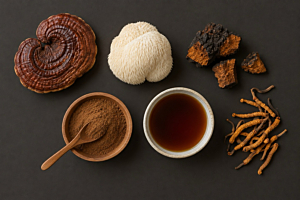
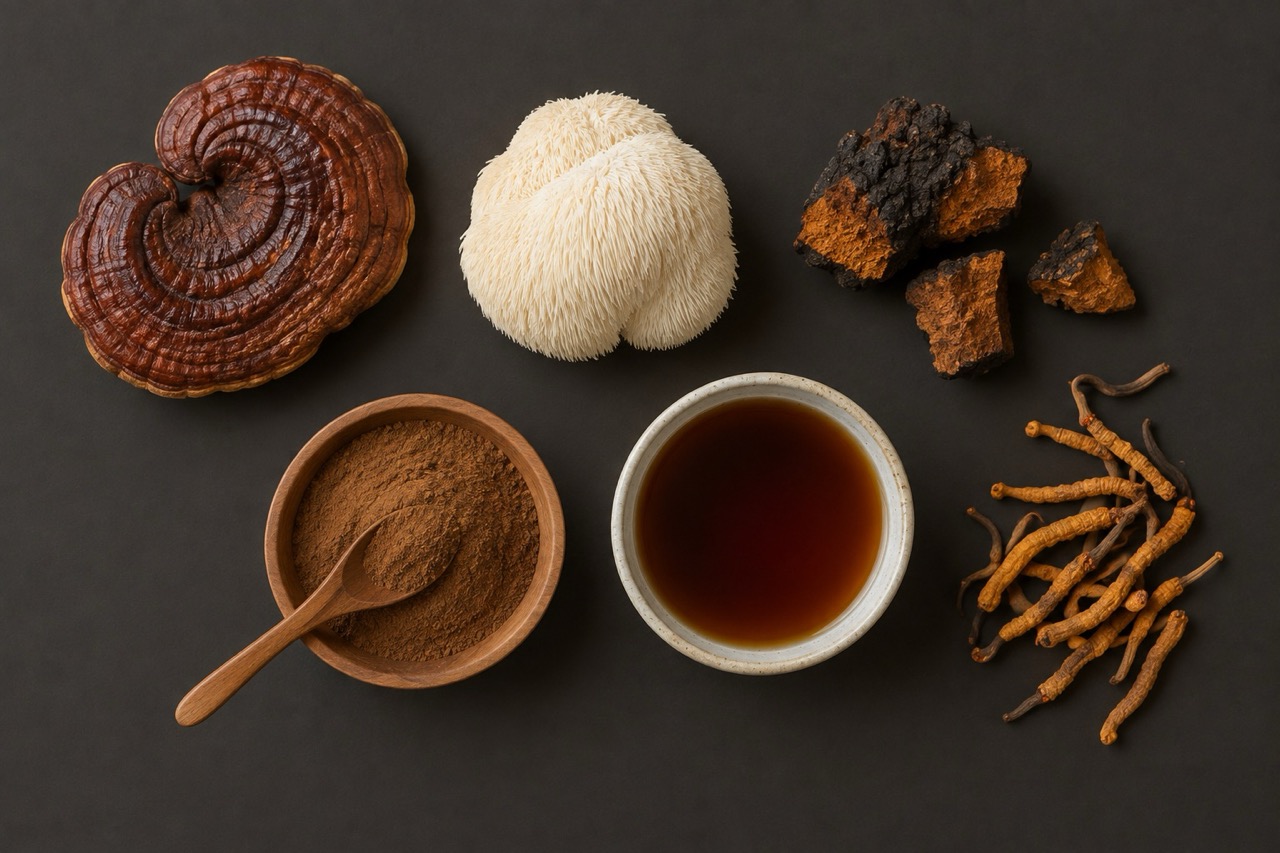
Reishi, lion’s mane, cordyceps and chaga have travelled from traditional Eastern and Carpathian folk practice to the shelves of modern health shops and to laboratories studying beta-glucans. Popularity brought a problem with it: products sold under the same name can differ tenfold or more in how much active substance they contain.
What follows is what these mushrooms actually do, which of them have a real evidence base, and how to tell a proper extract from expensive flour.
Why Mushrooms Work at All
The main group of compounds in functional mushrooms is beta-glucans, the polysaccharides of the cell wall. Immune cells in the gut recognise them through specific receptors and respond as if to an alarm with no real threat behind it, which gently trains the immune response. Beta-glucans are the main standardised quality measure for mushroom supplements.
The second group is triterpenes, especially in reishi. They are responsible for its characteristic bitterness and are studied for anti-inflammatory activity. The third group is species-specific: hericenones and erinacines in lion’s mane, cordycepin in cordyceps.
It is worth setting an honest frame straight away. Most research on functional mushrooms consists of laboratory work, animal studies and small studies in people. That is enough to speak of promise and general tonic effects, and not enough to claim more.
1. Reishi (Ganoderma lucidum): Calm and Stress Resilience
Chinese tradition called reishi the mushroom of immortality. Modern interest centres on its adaptogenic properties:
- Support for sleep quality and easier falling asleep, which is why it is taken in the evening.
- Helping the body adapt to chronic stress.
- Support for immune function through beta-glucans.
- Antioxidant activity, with liver function support also under study.
Reishi is very bitter, and that is normal and even desirable: bitterness signals triterpenes, which mycelium powders do not contain. Use caution if you take anticoagulants or immunosuppressants.
2. Lion’s Mane (Hericium erinaceus): Focus and the Nervous System
The most popular mushroom among people interested in cognitive function. Its distinctive compounds, hericenones in the fruiting body and erinacines in the mycelium, are studied for stimulating nerve growth factor (NGF).
- Support for concentration, clarity of thought and memory.
- Research into the peripheral nervous system and nerve fibre recovery.
- Support for the stomach lining, a traditional use for stomach discomfort.
- Small studies in people look at effects on mood and anxiety.
Take it in the morning or during the day. The effect is cumulative; judge it after 4-8 weeks of consistent use.
3. Cordyceps (Cordyceps militaris): Energy and Endurance
The mushroom studied in the context of physical performance: oxygen utilisation, ATP production and recovery after exertion.
- Support for endurance and energy levels without the stimulant effect of caffeine.
- Support for lung function and breathing, a traditional use.
- Research interest in libido and hormonal balance.
There is an important detail about the raw material. Cultivated Cordyceps militaris contains more cordycepin than wild Cordyceps sinensis, and it is affordable. Wild sinensis is among the most expensive products in the world, so cheap wild cordyceps on a label is a reason for doubt.
Reishi, lion's mane and cordyceps
See all Reishi, Reishi, EcoHuman, 500 mg, 60 capsulesSpecial Price 533 uah Regular Price 650 uah
 Hericium Erinaceus, Lion's Mane, EcoHuman, 500 mg, 60 capsulesSpecial Price 533 uah Regular Price 650 uah
 Cordyceps, Cordyceps, EcoHuman, 500 mg, 60 capsulesSpecial Price 533 uah Regular Price 650 uah
 Immuno Mix (Trametes + Reishi + Chaga), Imuno Mix (Trametes + Reishi + Chaga), EcoHuman, 500 mg, 60 capsulesSpecial Price 533 uah Regular Price 650 uah
 Hericium Erinaceus Extract 10:1, Lion's Mane Extract 10:1, EcoHuman, 500 mg, 60 capsulesSpecial Price 943 uah Regular Price 1 150 uah
 Cordyceps Extract 10:1, Cordyceps Extract 10:1, EcoHuman, 500 mg, 60 capsulesSpecial Price 943 uah Regular Price 1 150 uah
 Fermented Reishi, Org Grown Fermented Reishi, Solaray, 1000 mg, 60 capsulesSpecial Price 1 214 uah Regular Price 1 334 uah
 Cordyceps Extract 5:1, Cordyceps Extract 5:1, EcoHuman, 500 mg, 60 capsulesSpecial Price 779 uah Regular Price 950 uah
4. Chaga (Inonotus obliquus): Antioxidants and a Carpathian Tradition
A parasitic fungus that grows on birch, including in the Ukrainian Carpathians. Known for its high melanin and polyphenol content.
- One of the highest antioxidant activities among natural products.
- Traditional use for digestive support and general tone.
- Immune support through the cold season.
Chaga contains a significant amount of oxalates, so anyone prone to kidney stones should be careful and avoid long uninterrupted courses.
5. Three More Worth Knowing
- Shiitake (Lentinula edodes): lentinan, immune support, with effects on the lipid profile under study.
- Maitake (Grifola frondosa): researched in connection with glucose metabolism and insulin sensitivity.
- Turkey tail (Trametes versicolor): the polysaccharopeptides PSK and PSP, the most studied mushroom compounds in an immunological context. It also supports gut flora.
6. Fruiting Body or Mycelium
This is where the cost cutting happens most often. There are two fundamentally different products:
- Fruiting body extract: what we call a mushroom. High in beta-glucans, with the full range of compounds.
- Mycelium on grain (MOG): the fungus is grown on a grain substrate and milled together with it. The finished product can be 50-70% grain starch.
Telling them apart is not hard. If the ingredients mention myceliated brown rice or mycelial biomass, or do not say which part of the fungus is used at all, it is very likely MOG. A good product says fruiting body extract and states the beta-glucan content.
7. What the Label Should Say
- The beta-glucan percentage, not polysaccharides. Polysaccharides is a broad category that includes grain starch, which is exactly what unscrupulous manufacturers exploit. A good benchmark is 20% beta-glucans or more.
- The Latin species name, so you know precisely what you are buying.
- The extraction method. The chitin cell wall of fungi is indigestible for humans, so raw powder is of little use. Hot water extraction releases beta-glucans, alcohol extraction releases triterpenes. Dual extraction gives both groups, which is what reishi and chaga need.
- The extraction ratio. An 8:1 extract, for example, means 8 kg of raw material yielded 1 kg of extract.
- Heavy metal testing. Fungi are natural bioaccumulators and take up whatever is in the substrate, so the origin of the raw material is decisive here.
8. How to Take Them
- Morning: cordyceps, lion’s mane. Evening: reishi. Chaga and shiitake any time.
- In courses of 8-12 weeks with breaks, rather than continuously for years.
- The effect is cumulative; first changes are usually noticeable after 2-4 weeks.
- Mushrooms combine well with each other, and blends of 3-7 species are a common and sensible format.
- Mushroom coffee and drinks are a convenient format, but check how much extract is actually in a serving. It is often a token dose.
Use caution with autoimmune conditions, immunosuppressants or anticoagulants, and during pregnancy and breastfeeding, meaning only after consulting a specialist. An allergy to mushrooms is also possible.
ECO HUMAN mushrooms
See all Trametes, Trametes, EcoHuman, 500 mg, 60 capsulesSpecial Price 369 uah Regular Price 450 uah
 Chaga, Chaga, EcoHuman, 500 mg, 60 capsulesSpecial Price 287 uah Regular Price 350 uah

 Maitake, Maitake, EcoHuman, 500 mg, 60 capsulesSpecial Price 369 uah Regular Price 450 uah
 Shiitake, Shiitake, EcoHuman, 500 mg, 60 capsulesSpecial Price 287 uah Regular Price 350 uah
Why Choose EcoHuman?
Functional mushrooms are one of the categories where we are most demanding, because this is where the gap between products is widest:
- Fruiting body extracts with a stated beta-glucan content, not mycelium on grain.
- Our own formulas based on Carpathian mushrooms and herbs, from raw material of known origin.
- Dual extraction wherever the species calls for it.
- Single mushrooms and blends, depending on whether you have one goal or want general support.
- Advice that matches your goal (sleep, focus, energy, immunity) to a specific species.
Conclusion
Functional mushrooms are not magic, but a gentle support tool that only works when the jar genuinely contains the active substance. Remember three filters: fruiting body rather than mycelium on grain, beta-glucan percentage rather than polysaccharides, and an extraction method that matches the species. After that, choose by goal: reishi for calm, lion’s mane for focus, cordyceps for energy, chaga for antioxidant support. And give a course at least a month, because mushrooms work cumulatively.
Self-medication can be harmful to your health. Consult a doctor before taking dietary supplements.